Water Quality Metrics of Fishponds During the Cold Season, with a Focus on the Potential Risk of Metals and Microplastics
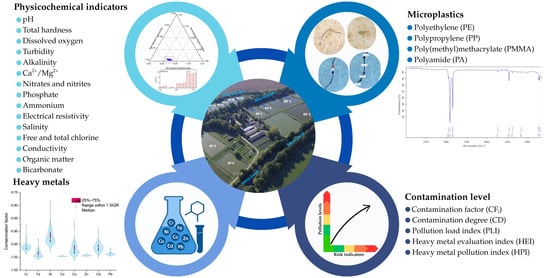
Aquaculture in ponds supplied by streams or rivers requires careful evaluation of key physicochemical parameters and potential pollution threats, particularly metals and microplastics. To address these challenges, this research aims to monitor daily climatic and physicochemical parameters and quantify potentially toxic metals and microplastics in the water of 19 fishponds in the SCDP Nucet, Romania, over one winter season (i.e., December 2024 to February 2025). During this season, unique hydrochemical conditions arise, such as lower temperatures, reduced light, and decreased activity, which can affect the ecological balance and fish health. Accordingly, a total of 4650 samples were collected and analyzed in terms of physicochemical parameters (i.e., alkalinity, bicarbonate, calcium ions, magnesium ions, Ca2+/Mg2+ ratio, organic matter, nitrates, nitrites, phosphates, ammonium, total hardness, resistivity, dissolved oxygen, conductivity, salinity, turbidity, free and total chlorine), metals, and microplastics. Statistical analysis revealed the influence of winter weather on water quality, highlighting links between air and water temperatures and physicochemical parameters. Furthermore, water analyses revealed notable levels of microplastics, including fibers and fragments of various colors, shapes, and sizes. Polypropylene, polyethene, and nylon were the most prevalent. While appreciable quantities of blue, green, black, and yellow fibers were found in size ranges (0.09–0.3 mm), irregular yellow fragments or translucent particles were found in sizes less than 0.5 mm. Metal (i.e., Cr, Fe, Ni, Co, Cu, Zn, Cd, and Pb) concentrations do not exceed the standard values set by national and European regulations. However, it is worth noting that microplastics can amplify or mitigate metal toxicity. The results emphasize the importance of integrated monitoring of physicochemical parameters and emerging pollutants during the cold season, thereby improving understanding of the chemical processes governing water quality in fishponds, providing scientific support for future environmental risk assessment, and promoting innovative, adaptive technologies.
Ask About This Story
Talk to Kesha, our AI correspondent
2,3,4,5,10,13,16, Global warming is causing significant changes in the location, timing, and frequency of extreme weather events, and higher temperatures are expected to shift the geographical distrib... [29181 symbols]